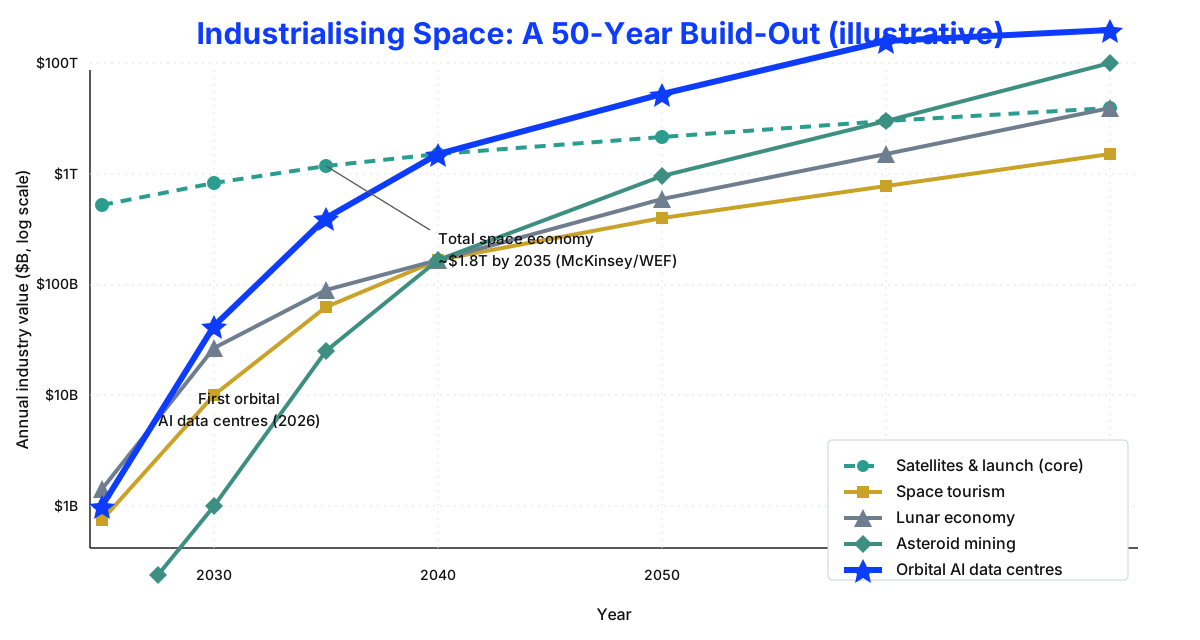
The first thing I noticed in this chart was not the moon. Or asteroid mining. Or tourists taking selfies with Earth in the background, because apparently even orbit will need Instagram.
It was the blue line.
Orbital AI data centres.
That sounds like science fiction until you remember that much of today's economy already sounds ridiculous when explained plainly. We put phones in our pockets that talk to satellites, trade money through invisible ledgers, and ask machines to write poetry, code, tax memos and break-up texts. So yes, AI data centres in orbit. Why not add cooling, energy, latency, launch cost, radiation shielding and regulatory chaos to the list?
The chart is illustrative, and that word is doing quite a lot of work. Still, the direction matters. Space is moving from exploration theatre to industrial infrastructure.
That shift is important.
For decades, space was mostly flags, rockets, national pride and a few spectacular photographs. Then satellites became boring, which is usually the moment when a technology becomes economically serious. GPS became boring. Weather satellites became boring. Earth observation became boring. Launch schedules became less magical and more like logistics.
Good.
Boring is where civilisation gets built.
The chart suggests a 50-year build-out where satellites and launch remain the core, tourism grows into a real market, the lunar economy starts to matter, asteroid mining arrives later, and orbital AI data centres become the wild card. On a log scale, each step is not a little improvement. It is a ten-times jump. The difference between one billion and one trillion is not a successful product launch. It is a new industrial layer.
This is where I think many people still underestimate space.
They imagine rockets.
The real story is supply chains.
Power. Compute. Materials. Insurance. Robotics. Maintenance. Regulation. Capital markets. Waste handling. Defence concerns. Labour. Standards. Someone will have to decide who fixes the server when it is 400 kilometres above Earth and has just been hit by a microscopic piece of junk travelling faster than a bullet. Have fun with that support ticket.
Yet the opportunity is real.
AI needs energy and infrastructure at a scale that already strains our imagination on Earth. Space offers strange advantages: abundant solar exposure, vacuum, physical separation, new orbital architectures. It also offers brutal disadvantages: launch cost, failure risk, debris, security, and the small inconvenience that humans are terribly fragile outside the atmosphere.
So the question is not whether the chart is precisely right.
The question is whether we are preparing for space as an industry rather than treating it as a spectacle.
That means investing in the unsexy parts. Launch reliability. Modular construction. Autonomous repair. Orbital traffic management. Better law. Serious safety standards. Less billionaire theatre, more industrial discipline.
Dear space industry, please keep the wonder. We need it. But bring the spreadsheets too.
The next space age will be built by the people who make orbit useful, reliable and boring enough to trust.
That is when the blue line becomes real.